
(Making Me Understand is an occasional blog feature where I analyze, in brief or at length, what a particular work of art or an artist means to me right now.)
Part I: Still/Here by Bill T. Jones
As a longtime cancer survivor, I carry a lot of guilt. In fact, a search of that term in my posts on this blog retrieves eight results (and I haven’t even searched “guilty.”) When I express my feelings of guilt out loud, my interlocutor is always quick to tell me I’m wrong, that I shouldn’t feel guilt. Of course I shouldn’t.
But guilt is one of those human qualities that tends to give the finger to rational thought. We can convince ourselves of our guilt in any situation. There’s perhaps only a select group of people who are able to live without guilt, and those are the people in the world who are the most evil and the most deserving to be ceaselessly plagued by guilt that keeps them from sleeping, eating, even functioning at the most minimal level. Unfortunately a greater than usual proportion of those people are in charge of my country right now. May they see justice, pay for their many crimes, and only then, may their names be erased. I certainly won’t dignify their names by typing them here.
This is a sentiment I know was shared by a melanoma fellow traveler, Megan, who died in late January. We met on a melanoma discussion board on Facebook a number of years ago. It took me a while to find a discussion board I felt comfortable in, because so many of them were prayerful and the language people used there felt alienating as a result. In the group where I met Megan, people cursed. A lot. People posted irreverent memes. I felt much more at home there, even though it seemed that a notice was posted on a weekly basis, if not more frequently than that, about a group member who had died. I befriended a few people in the group, but generally felt I might not want to delve too deeply, because of the heartbreak involved.
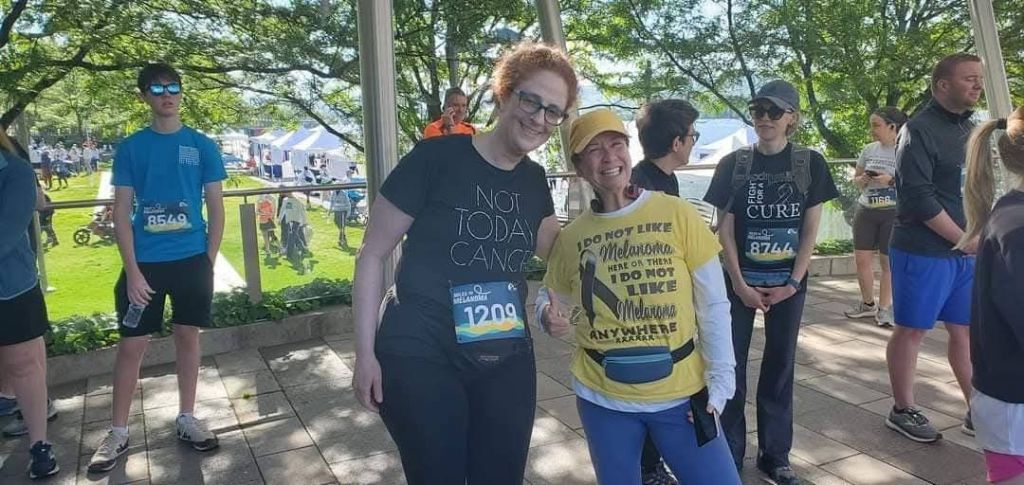
Lucky for me, Megan lived in my area, so we met and became friends. She and her husband Carlos were fun, energetic people, and we invited them to some of our parties, where they mingled easily and made friends. Megan and I did a 5K fundraising run for melanoma research in 2023, I think. I was barely able to move — middle age inertia has stolen the energy I once had for running. But Megan was delightful to watch. In spite of her many metastases and brain and other surgeries, she kept a brisk pace. While we were initially planning to cross the finish line together, I saw that I’d only be slowing her down. She waited just beyond the finish line for me to lurch across, in her bright yellow custom made t-shirt with a melanoma slogan on it.
Six days after Megan passed, J. and I had tickets for a modern dance performance. It was a staging of a landmark work by the choreographer Bill T. Jones called Still/Here. It premiered in New York in 1994, which was before my time living there. But I had certainly heard it mentioned in the modern dance circles I moved in when I lived there. But I had never gotten to see it until early February of this year.
Bill T. Jones founded a dance company with his partner, Arnie Zane. Both were diagnosed with HIV in the mid-80s, and Zane died of AIDS-related complications in 1988. Jones created Still/Here as a “movement meditation in the face of life-threatening disease.” (Still/Here: An Interview with Bill T. Jones, by Nicole J. Cunningham, Thomas Piontek and Bill T. Jones. Discourse, Spring 1994, Vol. 16, No. 3, pp. 78-85.)
The piece had its origins in a series of “survival workshops” which Jones conducted in the 1990s across a number of U.S. cities. The goal of the workshops was to hear stories from survivors of, and those living with, serious illness. But in these workshops, Jones also received movement from the participants, who were nondancers. Participants were asked to contribute a gesture which summed up their particular situation. These gestures were combined into a movement phrase, and each city’s workshop generated a movement phrase unique to that city. While the movement would eventually be manipulated by Jones and his dancers, it had its origin in these visceral workshops where survivors were speaking — and moving — their truths. These truths are complicated: gratitude meets anger meets disability. The movement in the piece, and the music commissioned to accompany it, reflect this complexity.
I didn’t know about any of this before seeing Still/Here. Because I went in cold, my experience of it was pure, and the moment the piece began, with dancers onstage speaking lines from survival workshop participants (eventually, we hear their own recorded voices, and see them on video screens), I found it hard to breathe. In fact I am not sure I did for the entire first half. (We didn’t realize there was a second part until we noticed no one was leaving.) It had been just a few days since my friend had departed this world, and just a few months since my aunt Vita had, and here I was, witnessing a work of art that had been composed more than 30 years earlier which affected me immediately and deeply.
I don’t think there are any random coincidences, when it comes to art hitting you. Art finds you when and where it needs to. Still/Here found me at a time I was most ready to receive its powerful and complicated message, and I won’t soon forget it. (By the way, Bill T. Jones was in the audience at the performance I went to see… an embodied testament to survival.)
Part II: O sândalo by Tom Zé
I don’t make New Year’s resolutions. The calendar that begins in January isn’t my soul’s calendar, which is calibrated to the Jewish new year in the fall. But at the end of 2025, I found myself pining for a class I took in Brooklyn that made me truly happy: samba dance. I decided to look for a local opportunity to resume studying samba.
As luck would have it, I found a studio ten minutes’ drive from my house, and since January, I have made Tuesday nights samba night. The class I found is taught by a woman who is relentless, driven, and determined to make everyone in the class smile, dance better, and feel exhilarated. In 90 minutes, I recapture the joy of movement I have felt my entire life, move to music I love, figure out how to translate the teacher’s movement to my body’s shape and length, sweat buckets, and stand there panting and amazed at the end of it all, smiling at my classmates as I take off my split sole dance sneakers and thrill at the new ritual I created for myself. Astonishingly, this class, unlike other fitness endeavors I have undertaken in recent years, has yet to injure me. I’m sore, sure, but I sleep well on Tuesday nights, and wake up refreshed.
This class is also connecting me to a part of my identity that has never made sense: I am Brazilian. I was born there, and am still considered a citizen, because I haven’t undertaken the arduous and bureaucratic process of renouncing that citizenship. My samba studies are only part of my increasing interest in immersing myself in Brazilian culture. I am considering studying Portuguese now. And my obsession with discovering the universe of Brazilian popular music (MPB, as they call it) continues and grows ever stronger as I hear new songs in class.
One Brazilian musical artist I have appreciated for a long time now is Tom Zé, a participant in the Tropicália movement in Brazil, a movement that had not only cultural, but political resonance. Tropicália arose in the 1960s, when Brazil was in the grips of a military dictatorship.
One song by Tom Zé which I have enjoyed for a few years now is “O sândalo” (“The Sandalwood [Tree].” It has an infectious rhythm and is one of those songs I tend to listen to many times in a row, confusing my music streaming app into serving me up nothing but Brazilian music for days. (I don’t necessarily mind.)
One night before samba class, I decided to look up the lyrics of the song, because I had been wanting to sing along to it in the car, but the Portuguese is sung so quickly it is a tongue twister for me. Also, I wasn’t sure why the word lavanderia (laundromat) was being repeated so many times in the song…
What I found was a metaphor couched in a funky, avant garde tune from 1972, the year I left Brazil as an infant:
Always just like an axe
That wounds the sandalwood, yet still expects to emerge perfumed
And still expects to emerge perfumed
Say your prayers once a day
And then send your conscience
Along with the bedsheets
To the laundry
Say your prayers once a day
And then send your conscience
Along with the bedsheets
To the laundry
To the laundry (to the laundry)
To the laundry (to the laundry)
To the laundry (to the laundry)
To the laundry
We don’t need to name names here to understand what is going on here. In any case, the names would be interchangeable. Scoundrels are all the same, regardless of which timeline or country they happen to populate.
I was born in a country that produced the highest highs of artistic achievement, and the lowest lows of political leadership. My parents came from a similar place. The United States turns 250 this year, and we have finally caught up to the rest of the world: Our lows couldn’t be lower. Our savage so-called guardians could not be more savage, nor less interested in our safety. Our scoundrels couldn’t be more the embodiment of sheer corruption and moral bankruptcy than the ones Tom Zé obliquely references in this song.
It’s hard to know where to begin, as AI addles everyone’s brain and things get progressively worse. Can we agree to dance? But dance hard, working up a sweat, until you feel you might fall over. This dance I speak of is its own metaphor. Can we agree not to let the axe off the hook? Remember what it did, regardless of what the axe tells you it is. Insist on the truth. Implicate the axe.
My samba teacher reminds us every week that there are two rules to samba: 1. Always start on your right foot. 2. Smile. Always smile. In light of the current climate I feel it’s important to note that we smile when we’re happy. Maybe we aren’t actually happy. But when we smile, we also show our teeth.
 I'll Live